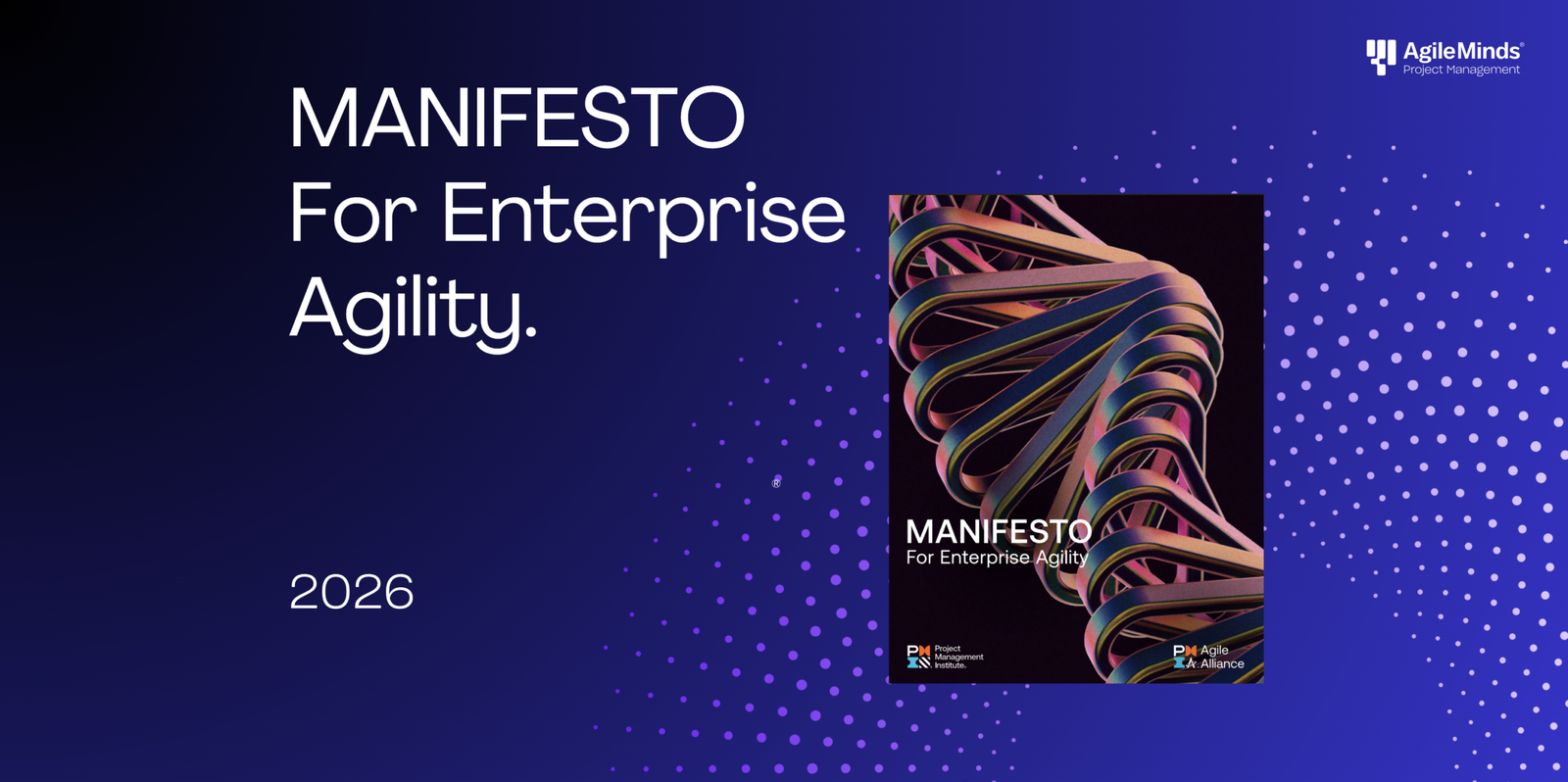
Twenty-five years ago, 17 software developers gathered in a Utah ski lodge and wrote a document that changed how the world builds software. The Manifesto for Agile Software Development redefined how teams work — and it sparked a global movement.
In March 2026, PMI and Agile Alliance did it again. But this time, the target isn’t teams. It’s the entire organisation.
The Problem No One Wants to Admit
Here’s a statistic that should make every executive uncomfortable: 85% of C-suite leaders say enterprise agility is critical to their organisation’s survival. Yet 65% admit they’ve barely implemented it.
That’s not a strategy problem. That’s a leadership and design problem.
Organisations are running on operating models built for a world that no longer exists — structured for efficiency, not adaptability. And the cost is becoming impossible to ignore: 93% of CEOs say they must rethink their business models at least every five years. 80% of employees report they don’t have the time or energy to do their work well. Change fatigue isn’t a buzzword anymore — it’s the top barrier to success.
The core question for CEOs is no longer “What is our plan?” It’s “Are we built for change?”
What the Manifesto Actually Says
The Manifesto for Enterprise Agility — co-authored by PMI Agile Alliance with over 100 global C-suite leaders, transformation experts, and academics — doesn’t prescribe a new framework. It offers something more powerful: a shared set of values and principles that help leaders make better trade-offs and design organisations that can adapt at scale without losing coherence.
It defines enterprise agility as “the capacity to adapt at scale without losing coherence — to decide quickly, redirect resources deliberately, and keep strategy actionable under real-world pressure.”
4 Core Values:
Clear purpose realised through adaptive plans — Lead with intent, not over-engineered roadmaps.
Shared enterprise outcomes over functional optimisation — Break the silo mentality that kills cross-functional momentum.
Continuous reinvention over preservation — Challenge the status quo before the market does it for you.
Human centricity amidst change — Resilience, learning, empathy, and trust are leadership capabilities, not HR initiatives.
9 Principles across three domains — Leadership Behaviour, Organisation Design, and Execution — translate those values into action: governing with guardrails instead of gatekeepers, funding strategic intent instead of activity, moving decision-making closer to where value is actually created, and designing operating models for adaptability, not just efficiency.
Why This Is Different From “Just Another Agile Framework”
The original Agile Manifesto was a response to the internet’s disruption of software development. The Manifesto for Enterprise Agility is a response to something bigger: AI, distributed workforces, interconnected global ecosystems, and the collapse of long-range planning as a reliable strategy.
As Jim Highsmith — original Agile Manifesto signatory and contributor to this new work — puts it: “We’re moving from a control mentality to a learning mentality. Twenty years ago, we thought we could control things. Today we clearly can’t, and that means we have to take learning much more seriously.”
This isn’t about scaling Scrum to the boardroom. It’s about a fundamental shift in how leadership operates: from hierarchy to co-creation, from individual authority to shared agency, from short-term results to long-term impact.
What This Means for Your Organization Right Now
You don’t need to overhaul your organisation overnight. The Manifesto suggests starting with three questions:
Do your teams know the why behind their work — clearly enough to make good decisions without asking for permission?
Is your governance designed to enable speed, or to gatekeep it?
Are you investing in sensing change early, or reacting to it late?
If the honest answer to any of these is uncomfortable, that discomfort is the point of departure.
At Agile Minds, We See This Every Day
The gap between strategic intent and organisational execution is the most common challenge we encounter with leaders across industries. The Manifesto for Enterprise Agility gives us — and you — a common language and a shared compass to close that gap.
This isn’t a transformation initiative with a start and end date. It’s a leadership orientation for the world we’re actually operating in.
Read the full Manifesto at pmi.org. Then let’s talk about what it means for your organisation.
Agile Minds® helps leaders and organisations build enterprise-wide agility — from strategy to execution. Connect with us to start the conversation.